COVID-19 - The Impact on Travel and Hospitality Industry and the situation ahead

COVID-19, the pandemic started its spread since November 2019 from Wuhan, a state in China. Since then as the virus spread across different developed nations like Italy, Germany, and the United States the world economy has suffered a shiver in its spine. On January 30th, the virus was declared a Public Health Emergency of International Concern. Affecting more than 185 Countries as on date, the virus has made major industries and hubs count each penny.
TRAVEL BANS
The Travel Industry was among the first to get the taste of the virus. There has been a drastic fall in the number of international flights and domestic flights as more than 100 countries have imposed travel restrictions for inter-country travel and there is restricted travel within the country facing the lockdown. The European Union sealed its borders to restrict any non-essential travel in March for 30 days.
The US has banned 26 Schengen Nations. In Addition to these, the ban was extended to the UK and Ireland.
Japan added more 14 countries to its ban list apart from the earlier 70 countries list. The Visa Ban and entry ban which was earlier set to end on April 30th is now extended to end of May
On March 18, India banned International travelers from the European Union, the United Kingdom, and 4 countries. Currently, the government has suspended all tourist visas and enforced a 14-day quarantine on travelers returning from China, France, Germany, Iran, Italy, South Korea, United Arab Emirates, Kuwait, Qatar, and Oman.
IMPACT ON THE AIRLINE INDUSTRY
Fall in the number of flights reaching 60% lower than that of January.

The International Air Transport Association conducted the latest analysis which showed that the global airline revenues drop by USD 314 billion in 2020, a 55% decline compared to 2019.
A Local company Flybe, which operated around 40% of domestic flights in the U.K went into bankruptcy amidst this pandemic situation in the month of March. The company as a result of falling travel bookings ran out of cash. The company was already in financial difficulties earlier, the COVID situation elevated its difficulties and proved to be a final blow to the company. Recently Singapore airlines have extended their flight cancellations until June. Earlier it was announced that the flights' cancellations will be till April end but now has been extended till June  |
| Source: IATA
Globally, it is assumed that the global air transport industry revenues could fall by $252 billion, 44 percent below 2019’s numbers.
 Comparing it to the prediction in March of $113 billion losses, the amount is more than twice the number. |
ONLINE TRAVEL AGGREGATORS
Online Travel operators also faced wrath. Expedia, a Seattle based group has already been a major sufferer. The stock prices fell more than 50% in March. As per estimates from RBC Capital markets, it is expected to face 57USD million loss.
Travel Advisory company, Trip Advisor of California, has announced cost control measures to overcome the cash reserve crunch. It has laid off 25% of its workforce as a measure. The majority of these 900 roles that are being reduced are the roles pertaining to US and Canada Locations.
Online Travel aggregators like MakeMyTrip‘s share declined from $29.95 on February 12 to $10.8 on March 18. Make My trip had an operating loss of 11 million dollars in Q3 2020, down by 19 million dollars in the same period the previous year. Further announcements to not charge any cancellation fee on flights canceled till Apr 30 will further impact the financials of the company.
Likewise, Yatra’s share price fell from $3.79 on February 14 to $0.91 on March 18. Not only the Flight bookings and Visa Cancellations have impacted these companies. As per a statement from COO of Yatra, 35% cancellation queries of trips planned to international destinations
Also, the circular from Govt. of India states all airlines are not charging any cancellation fees from passengers. However, when booked from a travel operator, the amount is refunded to a virtual wallet and not in cash, thus it cannot be transferred to bank accounts. Virtual Wallets are payment wallets maintained by OTAs with airlines to book tickets with customers. Such wallets to be topped up by agents to continue bookings in the future. Hence if the refund for booking cancellations increases then the limit of wallet balance with airlines will exceed. They have to then refund customers from their cash reserves which will affect the liquidity position further of these agencies.
HOSPITALITY INDUSTRY
HIT IN THE OCCUPANCY RATES
A 50.6% revenue-per-available-room decline in 2020 projection was released by STR and Tourism Economics which accounts for a 14.9% supply drop, a 51.2% demand drop, a 42.6% occupancy drop, and a 13.9% decline in the average daily rate.
With the holy Ramadan Month ahead, the highest footfall is seen in Middle east countries. However, as per recent data by STR for the week ending 21 March shows occupancy at the majority of hotels in the Middle East dropping below 30%. Dubai hotel occupancy dropped 75% in February and March, and Saudi Arabia’s holy cities of Makkah and Medina hit all-time occupancy lows, according to STR.
Similarly, in London and Dublin was down 80% for the week ending 22 March, compared to 2019. Prague which is flooded by tourists and travelers all around the year recorded a 97% occupancy decline for the same week.
As per a report from STR, the occupancy movement in February followed the following pattern :
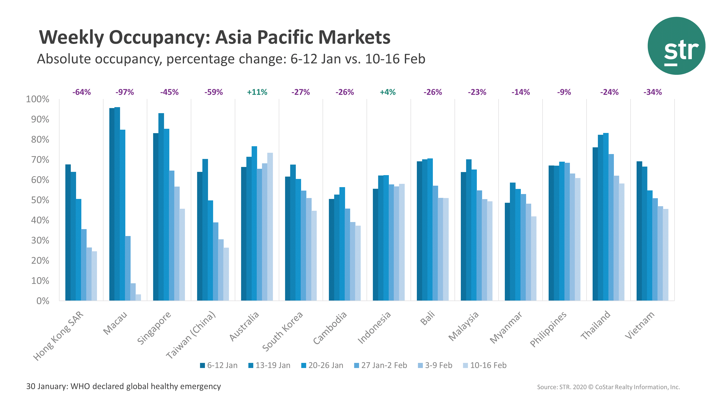 |
| Source: STR |
America is one of the largest industries in Hospitality. As per AHLA, approximately 4% of the total US workforce which amounts to nearly 8 million people are employed by hotels. In April, it was observed that there is a drastic 71% drop in hours worked. There are 85% of employees who are paid hourly by the industry. If we consider an average hourly wage rate of 15$ and assuming a 35 hour week, the drop is approximately 2.5 Billion USD. This calculation doesn't include the overtime paid, so the overall impact is much larger.
 |
| Source: AHLA |
Global Leader in the hotel industry, Marriot International has 25% of its locations temporarily closed. Occupancy levels at Marriott’s North American hotels are around 10 percent, and more than 870 hotels are temporarily closed. In Europe, occupancy is below 10 percent and about 500 hotels are closed. RevPar, a key industrial metric for the hotel industry, will be down 23 percent globally for the first quarter as per company announcements.
With the hottest stock market debut, Airbnb was all ready to set its foot but after the Pandemic it is expecting a 1USD billion loss in the first half. Even though the company is planning for a 1 USD Billion funding, but as per reports by the wall street journal, this funding comes at a steep interest of 10%. Similarly for Trivago sales are expected to decline a substantial 27% compared to the last 12 months.

SCENARIO OF INDIAN HOTELS
In India hotel Industry, there is an expected 900,000 Million rupee Loss expected this Calendar year as per HVS. There are 787 branded hotels in the country out of which 57% have become non-operational, a situation which this industry is facing for the first time. The Indian hotel industry was already facing an impact due to Yes Bank fiasco, Jet Airways shutdown, general elections, protests (albeit to a smaller extent) in the NCR region, and the lack of pick-up in corporate demand due to the economic slowdown and now COVID-19 impact has made the hotels' performance to crash. The overall revenue of the Indian Hotel sector is set to erode by 39% to 45% compared to last year thus reflecting a decline by anywhere between USD 8.85 billion to USD 10 billion.
The overall occupancy in the branded hotels segment in 2020 is estimated to decline by 16.7 to 20.5 % points over 2019. ADRs are expected to decline by 7% to 8% for the year. As a result, RevPAR will witness a significant decline of 31% to 36.2%. Considering losses due to fixed operating expenses, debt repayments, interest repayments, and several other compliances required of them the impact will be much higher.
Lack of bookings in hotels especially in Pilgrimage areas where tourists swarm throughout the year saw an 80% decline in bookings. Normally travelers pre-book their travel in the summer than in winter, however this year there was a steep decline.

Oyo Rooms which was considered one of the most successful startups in India is now under huge financial stress after the pandemic breakdown. The company has faced a decline in revenue of more than 50-60% in the last weeks.
The company's valuation of 10 billion USD with such financial stress is in a serious question mark. Due to COVID-19, the company's access to its largest market, India, will be deprived. This will be a dent in the company's ability to raise high capital valuations. The company's risk-oriented strategy in these situations will prove to be a time bomb that can blast anytime.
Below is the trend of the share prices of major hotels in the last three months
 |
| Source: NSE/BSE |
OUTLOOK IN POST COVID ERA and ACTIONS
AVIATION INDUSTRY
It can be said that the Government will, Policies, Cash saving mechanisms, Capital Management, Mergers, and Partnerships are some of the key factors which will be prevalent in Post-COVID for the aviation industry. Considering the first scenario of companies to maintain sufficient liquidity and cash reserves to have a relatively stable balance sheet, government involvement will play a key role.
- The Nationalization of many companies can be another outcome. For example, in the UK the British airways are one of the largest carriers, but smaller airlines like Virgin Atlantic and Easyjet which have already sought out to the government for funds may be subjected to nationalization. Similarly, Airitalia is another such case in Italy. In Australia, for Qantas and Virgin Australia, it may be the case. Though the US and UK may see more government support to carriers and less probable nationalization cases, in countries like Germany, Italy, France, and Australia it is highly probable.
- Support by the government for financial stability, in a recent announcement by Trump Administration, to save the aviation industry from drowning into bankruptcy amidst the COVID situation Airlines have been supported by the Government with the medium of payouts. The government has reached an agreement with major airlines. The Bailout will be of 25 billion USD. This step was majorly taken to save the economy in these situations. This will help the companies pay their workers and save the industry which has a major contribution to the economy, thus protect the taxpayers. Another 4Billion USD is available for Cargo carriers and 3billion USD for contractors.UK Government denied any bailout to the airports even after the bankruptcy of Flybe. The industry would have to rely on broader aid packages covering 80% of salaries – below a cap – for furloughed employees. But subsequently, the government quickly gave EasyJet a £600 million loan and the company has also mentioned that it will borrow another 500million USD from commercial creditors. As per the statement from the chancellor, Rishi Sunak, UK will consider the case-to-case basis for different companies.
The scenario when the industry opens would be a lot different. Changes in Prices, routes, flights running, schedules, safety mechanisms, etc. would be observed. Airports would start to ensure not a large crowd is present at a single point of time, hence reporting time changes would be possible. Automatic ticketing and baggage drops would be some probable changes in the near future. Mechanisms like sanitizing tunnels, thermal scanners would be prominent. Similarly, airport buses would not carry full capacity and there would be changes in on-flight meal policies as well.
Anticipated Outcomes
Based on the above presumptions, the possible outcomes can be explained for different category of travels in a timeline described as below
The level of rebound will depend on customer behavior, company financial and operational capabilities as well as policies.
Similarly, an analysis was conducted by BCG categorizing the economic recovery in five different potential scenarios as below

Another firm, Roland Berger predicted three possible outcomes as shown below :

Scenario 1 is a V-shaped curve where the pre-crisis demand is resumed in 12 months' time and the key focus of the industry will be to maintain production levels. Ten-year demand falls to only 4%. This is a rebound case scenario where the market structure is predicted and the market is expected to show optimistic behavior
Scenario 2 is a U shaped curve where the demand falls by 27% in ten years. With such a drastic fall in demand, the production levels would be significantly affected. Product mix changes can be expected. This is more of a delayed revival scenario where the industry will be impacted strongly and there may be many cases of insolvency of small carriers. Cash position and financial strength will be crucial for sustenance.
Scenario 3 is an L shaped curve where demand may fall to at least 50% over ten years. This is a recession type scenario where the industry will be significantly impacted and a lot of restructuring will be observed. Product mix and operational changes would be observed as mentioned in scenario 2. Pricing strategies and disruptions can be a key change in these situations. Insolvency of small carriers in bigger countries where the industry is not dependent on a single flight carrier will be taking place. However, in countries like Thailand where single flight carrier affects the industry, government policies will play a crucial role.
Taking note of the above scenarios, there may be a huge change in prices, routes, services offered, Airport regulations can be observed to be more stringent especially related to safety and security. However, as soon as the travel restrictions both international and domestic are lifted, a short span of demand rise may be observed when immigrant workers would be flying back home, employees who were on a holiday before the restrictions would fly back to resume work.
Initially, the airlines can be expected to charge high to passengers as the number of passengers traveling would be less firstly due to safety concerns by passengers; so smaller aircraft can be seen more frequently than bigger ones. Secondly, airlines would have to continue to follow the social distancing norms so lesser occupancy rates and higher prices. In addition to this, stranded passengers would have no other option but accept these rates to return back. Companies would target to take advantage of the situation as mentioned above to refuel cash and improve the balance sheet.
Recovery Plan of the airlines will no doubt be in a phased manner. However, the following can be observed as the recovery phases take place :
1. Flight routing optimization and passenger occupancy in the airlines will be revisited by each airline at least in the initial phases when consumer sentiment will be low to travel owing to safety and health precautions. Data based tools and organizations will play a crucial role in playing the consulting role in these cases. Flight Commissioning and maintenance scheduling, crew and ground team development and re-boarding, and passenger needs identification for commercialization of flights would require insightful data and analytics for decision making. Hence it wouldn't be a surprise if airlines would be taking the support of Big Data companies
2. Network modeling would be the second most significant factor which the airlines would consider for resuming the operations. Optimized networking would be ensured based on again the data as mentioned above. Network redesigning would have to be planned in the initial phases when the demand is brink and starts growing to accommodate the rising demands. There may be a scenario where new operating structures could emerge. However proper data-oriented decision making has to be followed to ensure a proper balance between profitability and performance.
3. Technology would play a significant role in supporting the industry to resume operations in a phased manner. Automation, AI, Big Data, and Digitalisation would play a key role. Speaking Category wise, Manufacturing will be a key area where technology would play a key role. Tier-1, Tier-II, and OEMs would strive to bring back the industry to running conditions from the current standstill. Operational excellence would be playing a crucial role. Spares for existing air crafts that have been grounded for a long time, resuming new aircraft production, maintenance of running aircraft, safety audits, etc. are some areas which companies would focus on. Another key area will be the supply chain to ensure lean and Just in time procurement and supply of parts by tier-1 and tier-2. Parts tracking, scheduling, stock management will be some specific areas. Thirdly, ground staff would need to be well equipped with advanced digital devices to flawlessly manage the traffic and passengers. To manage the initial surge in demand and to frame strategies to efficiently manage traffic in recovery stages, digitization would play a crucial role
4. Witnessing the current financial situation of the industry, a key factor for the industry to recover will be to ensure a stable balance sheet and cash situation by the companies. Government findings will be a crucial parameter that will help companies in future stabilization.
The functioning of the hospitality industry is dependent on some key factors like volume of capital available, performance of the industry as a whole based on demand, occupancy rates, Financing measures availability. When enough capital is available and financing measures are favorable, it attracts more funding and investors. However in this case, when the economy has had a last nail in the coffin due to the pandemic owners refrain from selling their assets, investors' funding availability reduces. even the debt that is available has lower leverage and high-interest rate. Thus impacting a cyclic investment pattern in the market.
For example, in early 2009 when the market started to fall due to economic crisis transactions started to decline significantly and it hit the rock bottom in early 2010. Right at this time, when EBITDA was the lowest, the market predictions were already set it to go up. At this time, major acquisitions, investors getting attracted causing an inflow of funding. Well capitalized hotel investors, including REITs and private equity funds, pursuing the purchase of large, high-quality assets as well as increasing sale of higher quality limited-service hotels caused a dramatic rise in hotel price per room in 2010 and 2011 as well as the average price per key ( total sales volume in a given period by the total number of rooms transacted )
The below chart by RCA shows the movement of the average price per key over the years
 |
| Source: RCA |
In the hotel industry, two key parameters-- Capitalisation rate and price per key correlate inversely. Thus as prices decline, capitalization rates typically rise until the hotel's operating performance bottoms out. Capitalization rate takes into account the earning of previous years, so since the current earnings are lower compared to previous earnings and current earnings the capitalization rate rises. Apart from this, the pressure on the cost of capital as a result of limited financing availability also impacts the capitalization rates.
Anticipated Outcomes
HVS predicted a valuation model and divided the outcome into three different scenarios: |
| Source-HVS |
Keeping in mind the above scenarios, the most probable outcome of the impact caused to a different segment of hotels are presented below

The recovery plan of the hospitality industry will no doubt be a transformative manner which would dramatically change the way the industry operates in the future. However, the following can be observed as the recovery phases take place :
1. Supply chain strategies will be revisited by the companies primarily to ensure efficiency in demand forecasting and supply availability. Backward integration may be observed in many cases primarily to ensure reliability in terms of the safety of goods and secondly to ensure availability. Digitization of the supply chain is another major area that will take place in the post-COVID era. These two factors would be essential towards making a strong commitment to meet sustainability goals and build a resilient business
2. Inventory Management will be a key area where the companies will focus on. The early period post-COVID era would see a rise in demand in business travelers but not for long. Managing inventory in an optimized way to ensure capacity utilization will play a significant role to achieve cost control measures.
3. Safety and security will be a must factor in the hotels. De-Contamination of rooms, timely sanitization, ensuring occupant safety both during entry, and stay till exit would be a key service management criterion. Customer food and stay patterns would be very different post-COVID. More focus on health and safety will be observed, both in lodging as well as in eating habits. Hotels focussing to maintain a healthy and clean environment would attract more crowds. Traditional menus may be seen to be having the last bite. Hotels may start using social media platforms like Wechat, Whatsapp, Telegram, etc. to interact with customers regarding the menu, Bookings. Thus, adhering to social distancing and contactless approach. One time use cutleries may be presented to customers at the dining table, box sealed food deliveries to rooms. There may also be a consideration to have the room cleaned and sanitized in front of the customer to assure them of cleanliness, unlike the way it is done currently in the night. Sanitized tunnels and thermal scanners may be kept at the entry and exits.
4 Asset management and utilization strategies would be an essential approach that would be required by hotel owners. They would need to optimize asset strategy, refurbish or renovate high potential assets, and enhance asset competitiveness to cater to changes in customer needs. For low performing assets they may look to sell off the assets or settle to rebrand or renovate for brand repositioning
5. Technology will play a key role with AIs and data-driven approach being a key area. For example, Single-use Key cards may be generated through automated machines after scanning the QR code from social media accounts. As mentioned above, social media as a platform can be used to facilitate services. Containment scanners, transparent supply chains with real-time tracking would be some of the probable technology disruptions which would be observed.
6. The financing and insuring would definitely be different than what it is now. Changes in policies related to these fields will be highly probable.
Below chart shows a brief anticipated action plan based on the different timelines for these industries:

Closing Note:
As these industries pull up their socks to plan recovery from this pandemic, Holistic planning following the 7s strategy of Mckinsey would be one of the approaches. Strategy, Structure, Systems, Shared values, Style, Staff, and Skills are the key areas where these companies have to focus on. Risk management scenarios both in Cash controls, demand, and supply management will be another area where these companies would have their special attention.
It cannot be ignored the pandemic has caused a huge loss to both travel as well as the hospitality industry, but this gives an opportunity to both these industries to evolve in a new ecosystem. It will be quite interesting to witness what major disruptions would be taking place across the globe after the pandemic is over. Many ruling leaders might fall to lower levels of market share while many underdogs may emerge as leaders. Startups especially which cater to digital services and data would be the catalyst in this transformation
It cannot be ignored the pandemic has caused a huge loss to both travel as well as the hospitality industry, but this gives an opportunity to both these industries to evolve in a new ecosystem. It will be quite interesting to witness what major disruptions would be taking place across the globe after the pandemic is over. Many ruling leaders might fall to lower levels of market share while many underdogs may emerge as leaders. Startups especially which cater to digital services and data would be the catalyst in this transformation
Posted by : Soumya Surya Adhikari
Disclaimer:
- The above data has been collected from various sources and the ownership of the accuracy and reliability of the data is with the sources.
- The data is as per the market movement in a specific period of time. The analysis may vary as the market evolves.
- The views and opinions in the blog are personal
- The blog provides a piece of anticipated information based on the available data and should not be taken as a professional advice
- The rights to the blog rest with the owner and any changes or modifications to the content is as per owner's discretion
Comments
Post a Comment